





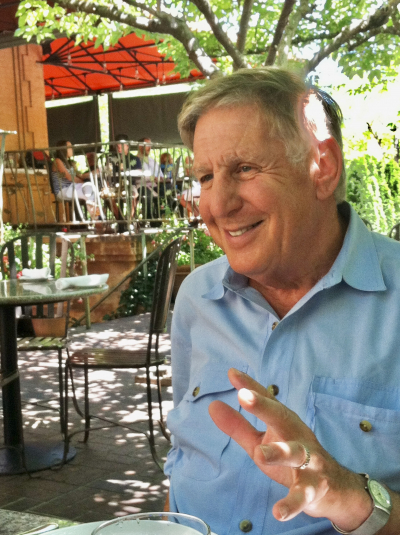
Thomas Trebitsch Parker
Aug. 2, 1943-March 15, 2026
Menlo Park, California
A born storyteller, Thomas Trebitsch Parker was a writer who told other people’s stories, sometimes earning himself and those he wrote about, like baseball great Dave Winfield, a place on the New York Times bestseller list, with “Winfield: A Player’s Life.” Other notables with whom Parker collaborated on books about their singular lives included Sandra Kurtzig, the first woman to take a Silicon Valley technology company public, and Dr. Narinder Singh Kapany, widely recognized as the “father of fiber optics.” Parker also wrote the award-winning novels “Small Business” and “Anna, Ann, Annie,” and was co-author of numerous business books. His first published short story, “Troop Withdrawal: The Initial Step,” about an Army sergeant who removed troops from Viet Nam thanks to his understanding of how paper moved within the military, appeared in Harper’s Magazine and received the O. Henry Award, which recognizes outstanding works of short fiction.
Born in Manhattan on August 2,1943 to Eric and Hedwig Trebitsch — refugees from Austria who met in New York City and later changed their surname to Parker — Tom and younger brother Ken (who would grow up to become an acclaimed flamenco guitarist) moved to Cape Cod with their mother. After her death, the brothers were placed at the straight-from-a-Dickens-novel Boston Farm and Trades School (later Thompson Academy) on an island in Boston Harbor where, after a welcoming by his classmates that included being hung by his belt buckle on a meat hook, Tom took on various roles, including night watchman, head of the print shop, and captain of the tennis team, which had no other players (hence, his killer serve). Among the first from the school to attend college, Parker applied only to places in warm locations after Boston Harbor froze and found himself enrolled as a freshman at Stanford University, quite unprepared. But he rose to the challenge — through his inherent smarts, his survival skills, and perhaps most of all, his humor. He was funny — with his verbal dexterity, prowess at pranks, and always that one eyebrow inevitably raised that was his signature. He worked his way through school with a variety of jobs — setting up pinball machines in fraternity houses, forming a business with friends to sell Madras shirts — all the rage at the time—and cooking at resorts in Maine during summers.
At Stanford, from which Parker graduated in 1965, he joined Beta Chi, which left the national Sigma Nu fraternity in protest of its racial exclusion rules. Stanford’s legendary writing professor, Nancy H. Packer, became his mentor and one of his closest lifelong friends. During the waning days of Tom’s life, his wife, Kathy, read him one of Packer’s short stories, as he lay in bed. Eyes closed, Tom seemingly falling asleep, Kathy said she would restart the story later. “Why?” Tom asked. “I’m enjoying it,” the most he’d said in days. So his wife continued to the end at which point she commented, “It’s as if Nancy is in the room with us.” Her husband agreed.
Parker served in the Army Reserves, earned his master’s degree in creative writing from San Francisco State University, and went into business in 1970s San Francisco with partner Paul Crowley. Their company, Media West, created first slide shows, then elaborate multimedia productions for corporate meetings and events. Parker’s novel, “Small Business,” was an evocation of this time, during which he met his soon-to-become wife, Kathy, on a blind date; they were married for fifty years. Their son, Gabriel, made their family complete. A prior marriage had ended in divorce.
In addition to writing books, short stories, speeches for executives, and corporate presentations, Parker taught writing classes for years — at Stanford, the University of California, Cañada College, Foothill College, and privately. These private classes — held at his studio on Ramona Street in Palo Alto and his home in Menlo Park — became the writing salon of the San Francisco Peninsula, attended by many from across the Bay Area who themselves became published authors.
When he wasn’t writing or teaching, Tom loved to play tennis, cook, read, and spend time with family and friends. Most of all, he lived his whole life as a humorist who delighted in making the unexpected witticism, often at the most serious of times. On a gurney at the ER a few weeks before his death, barely able to speak, his once expansive voice weakened by Parkinson’s, he suddenly uttered a single word: “Rosebud.” Everyone in that room who had seen “Citizen Kane” roared. Tom’s wife asked their son, “How is he still funny?” They looked at his face: eyes were closed, no expression save the one giveaway: that single raised eyebrow — his signature. He was a funny man. Even in the ER not knowing if he would ever come home again. He passed away peacefully at home on March 15, 2026, survived by wife Kathy, son Gabriel, brother Kenneth, and niece Cela. A Celebration of Life will be forthcoming.
Tags: veteran, arts/media, teacher/educator, business
